Commercial Cleaning Experts
  • Commercial Cleaning Services
        • Janitorial Services
        • Day Porters
        • Deep Cleaning Services
        • Clean Room Services
        • Construction Cleaning
        • Hard Floor Cleaning
        • Carpet Cleaning
  • Industries
    • Commercial Office
    • Medical
    • Warehouse/Distribution
    • Industrial Facilities
    • Education
    • Clean Room
  • About Us
    • Areas We Serve
      • Minnesota
      • South Dakota
      • North Dakota
        • Bismark
      • Michigan
      • Wisconsin
    • Blog
    • Careers
  • (763) 421-9554
  • Contact Us
  • Menu Menu

Terminal Cleaning in Minneapolis: Requirements for Hospitals and Clinics

Terminal cleaning is the full reset of a clinical space. When it’s done properly, environmental risk drops, survey readiness improves, and staff have confidence that rooms are safe for the next patient. This guide explains what terminal cleaning involves, when it’s required, and how Minneapolis hospitals, ambulatory surgery centers, and clinics structure the work so results are consistent and defensible.
Definition and Scope of Terminal Cleaning

Terminal cleaning goes beyond a quick turnover between patients. It is a structured, top-to-bottom process that occurs after patient discharge, after the final case of the day in procedural areas, or when a room’s risk profile demands a complete decontamination. In practical terms, terminal cleaning for Minneapolis programs treats the procedure as a documented method with defined steps, defined products, and verified dwell times. The objective is a measurable reduction of pathogens on high-risk and routine-touch surfaces, supported by staff training and audits.

Risk-Based Triggers in Minneapolis Hospital Terminal Cleaning

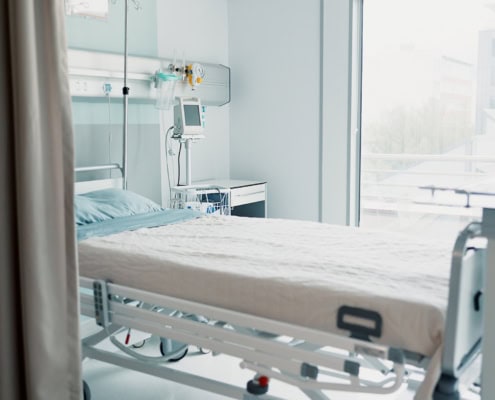
A clear trigger list removes guesswork. Inpatient rooms receive terminal cleaning after discharge, isolation rooms after discontinuation of precautions, and operating rooms after the final scheduled procedure or after a contamination event. Ambulatory surgery centers and clinics apply the same logic to exam, treatment, and procedure rooms, with isolation and negative-pressure spaces prioritized. Consistency matters more than complexity. A defined trigger should always lead to the same documented response, regardless of shift or unit.

Regulatory Framework and Survey Expectations

Terminal cleaning is shaped by three pillars of oversight. The Centers for Disease Control and Prevention provides recommendations on environmental infection control and healthcare disinfection that inform product selection and contact times. Occupational Safety and Health Administration rules govern worker protection, exposure control, and chemical handling. The Joint Commission validates that policies exist, staff are trained, and evidence of performance is available during surveys. Aligning policy language with these sources maintains compliance and shows a united front across Environmental Services, Nursing, and Infection Prevention.

Terminal Cleaning Procedures Healthcare Teams Rely On

A good procedure reads like an operations script. It explains what to do, in what order, with which tools, and how results are verified. The outline below adapts to inpatient rooms, procedural spaces, and outpatient clinics.

  • Preparation and Safety: Post signage, gather the correct personal protective equipment, stage color-coded tools, and verify labels and expiration dates on disinfectants. Review contact times before work begins.
  • Room Reset and Waste Removal: Remove waste and linen, secure sharps, segregate regulated medical waste according to policy, and replace liners. This step prevents cross-contamination during surface disinfection.
  • High-to-Low, Clean-to-Dirty Progression: Start with the highest reachable surfaces, then move downward, touching each zone once. Address vents, lights, monitors, cords, IV poles, door hardware, and other frequent touchpoints. Work clockwise or counterclockwise to reduce misses.
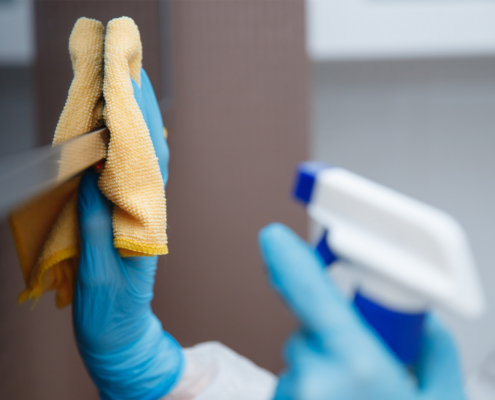
  • Disinfection of High-Touch Surfaces: Apply approved hospital-grade products to bed rails, call buttons, chair arms, counters, keyboards with approved covers, phones, and handrails. Maintain the required dwell time. If a surface dries early, re-wet to complete the contact time.
  • Patient-Care Equipment and Accessories: Wipe pumps, stands, vital signs equipment, and reusable accessories in accordance with device instructions and facility policy. Separate clean and dirty zones during staging.
  • Restroom Detailing: Clean and disinfect fixtures, partitions, dispensers, and floors using dedicated tools. Replace consumables and ensure seats and lids receive the same contact time as other hard surfaces.
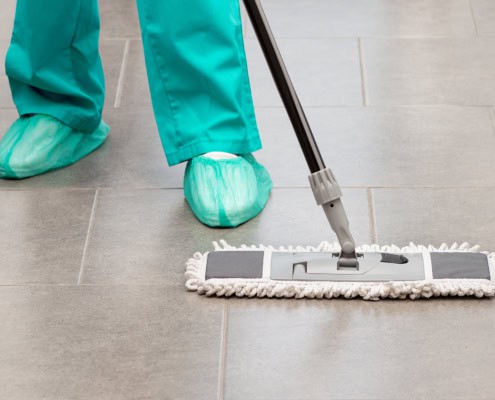
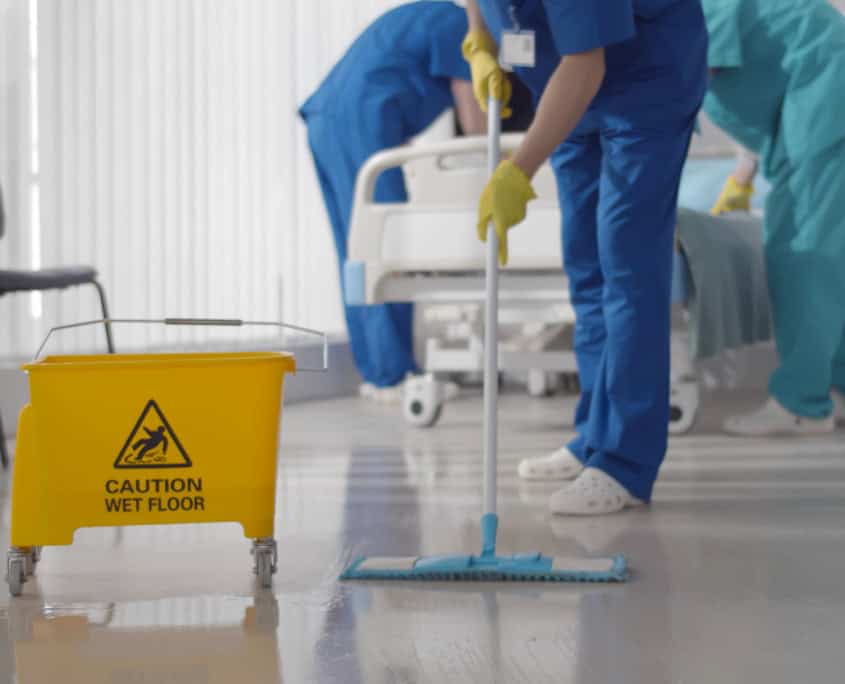
  • Floors and Baseboards: Damp mop from the far corner toward the exit using a two-bucket or disposable mop system. Address edges and baseboards where soil accumulates.
  • Final Inspection and Sign-Off: Complete a visual check, close the room, and document completion with the required checklist or digital form. Supervisors perform spot audits on a set cadence.

Well-written procedures shorten onboarding, reduce variation, and make audits straightforward.

Disinfectants, Dwell Times, and Surface Compatibility

Product selection should match the expected pathogens and the materials in the room. Quaternary ammonium compounds, accelerated hydrogen peroxide, and sodium hypochlorite each have strengths and limitations. Some device housings and displays are sensitive to certain chemistries, so manufacturer instructions need to be part of the policy. Keep an approved product list with contact times on carts and in service closets, and train teams to re-wet surfaces when evaporation occurs before the full contact time. Routine fogging is generally not necessary for environmental surfaces. If adjunct technologies are considered, validate outcomes with audits rather than substituting them for wipe-based disinfection.

OSHA Terminal Cleaning Standards: PPE and Worker Safety

Protecting staff is integral to protecting patients. OSHA requirements apply through the bloodborne pathogens standard, hazard communication, and personal protective equipment rules. Teams need training on exposure control plans, safe chemical handling, spill response, and hand hygiene that is enforced through daily supervision. Where respirators are required, program elements include medical evaluation, fit testing, and ongoing user training. An effective safety program lowers incident rates, stabilizes staffing, and maintains continuity of service across shifts and seasons.

Do you need an objective review of terminal cleaning policies, checklists, or staffing assumptions in Minneapolis facilities? Commercial Cleaning Experts reviews the draft and arranges a walk-through that validates room lists, risk triggers, and audit cadence.

Explore Our Solutions

Documentation and Proof of Performance

Auditors look for alignment between policy and practice and evidence that the work happened as written. Effective documentation typically includes:

  • Room Checklists or Digital Records with date, time, and staff initials for each terminal event.
  • Supervisor Audits on a recurring schedule, complete with pass rates and corrective actions.
  • Training and Competency Files showing initial instruction, return demonstrations, and annual refreshers linked to terminal tasks.
  • Product and PPE Listings that match what is on carts, including contact times and Safety Data Sheets.
  • Incident and Corrective Action Files that demonstrate how issues were resolved and verified.

When documentation is built into the workflow, terminal cleaning programs withstand Joint Commission scrutiny and internal quality reviews without last-minute scrambling.

Staffing, Scheduling, and Supervision

Terminal-level work adds minutes to room readiness, so staffing must reflect that reality. A practical matrix ties labor hours to patient volumes, case counts, and the physical layout of the facility. Surge planning for respiratory season, high census, or environmental events prevents last-minute coverage emergencies. Supervision structure matters as well. Many programs pair a working lead with a small team for real-time coaching, then assign an on-site manager to handle audits, service tickets, and coordination with clinical leaders.

Training That Transfers to Daily Practice

Policies are only as strong as the training behind them. Competency-based instruction turns expectations into habits. Focus modules on isolation protocols, room-type variations, dwell-time discipline, and prevention of cross-contamination. Use return demonstrations, short refreshers, and in-room coaching rather than relying solely on classroom sessions. Track participation, observed skills, and retraining after any audit miss. Over time, the data will show where reinforcement has the greatest impact.

Measurement That Drives Improvement

Quality programs depend on metrics that are simple to collect and meaningful to clinicians. Useful indicators include terminal clean pass rates by unit, time to ready after discharge or final case, high-touch completion rates, and closure time for corrective actions. Share results in standing meetings with Nursing and Infection Prevention. Patterns in the data often reveal staffing gaps, layout bottlenecks, or product issues that deserve attention.

Procurement Considerations for EVS Leaders

Strong outcomes start with strong specifications. RFP language that includes room lists, triggers, product families, PPE requirements, training expectations, audit cadence, and documentation formats leads to proposals that are easier to compare and easier to manage. Pricing transparency matters as well. Separate tabs for routine work, specialty events, and emergency response support total cost evaluations, not just hourly rate comparisons. Vendors that respond with clarity and data are easier to hold accountable.

From Policy to Daily Practice in Minneapolis Healthcare

A resilient terminal cleaning program balances patient safety, regulatory alignment, and operational flow. Facilities that codify triggers, train for room types, stock appropriate products, and audit against a posted checklist avoid last-minute chaos during survey season. Teams remain prepared because expectations remain visible, and leadership has data that supports staffing and product decisions. That is the foundation of terminal cleaning stakeholders expect across hospitals and clinics.

We Offer Expert Terminal Cleaning Support for Minneapolis Facilities

Commercial Cleaning Experts supports hospitals, ambulatory surgery centers, and clinics across Minneapolis with programs designed for terminal cleaning and daily environmental services. Services include daily janitorial, day porter coverage, terminal cleans, isolation-room protocols, hard floor care, carpet care, and clean-room support.

Expect documented SOPs, supervisor-led training, and transparent reporting aligned with regulatory expectations. Share a draft policy or RFP to start a focused conversation, request a facility walk-through to confirm room lists and triggers, and request a proposal that matches the scope. That sequence converts policy language into reliable results at the room level within terminal cleaning programs.

Share This Post

  • Share on Facebook
  • Share on X
  • Share on WhatsApp
  • Share on Pinterest
  • Share on LinkedIn
  • Share on Tumblr
  • Share on Vk
  • Share on Reddit
  • Share by Mail

More Like This

Questions to Avoid When Hiring a Commercial Cleaning Partner

Vendor Evaluation
https://cleanworkplaces.com/wp-content/uploads/2025/11/Questions-to-Avoid-When-Hiring-a-Commercial-Cleaning-Partner.jpg 1250 2000 Abstrakt Marketing /wp-content/uploads/2024/02/Logo-Edited.png Abstrakt Marketing2025-11-07 07:41:302026-05-07 14:18:21Questions to Avoid When Hiring a Commercial Cleaning Partner

The True Cost of Switching Cleaning Companies Too Often

Compliance, Vendor Evaluation
https://cleanworkplaces.com/wp-content/uploads/2025/10/The-True-Cost-of-Switching-Cleaning-Companies-Too-Often.jpg 1250 2000 Abstrakt Marketing /wp-content/uploads/2024/02/Logo-Edited.png Abstrakt Marketing2025-10-13 10:16:582026-05-07 14:18:23The True Cost of Switching Cleaning Companies Too Often

What Minneapolis Facilities Should Include When Requesting Proposals

Vendor Evaluation
https://cleanworkplaces.com/wp-content/uploads/2025/10/What-Facilities-Should-Include-When-Requesting-Proposals.jpg 1250 2000 Abstrakt Marketing /wp-content/uploads/2024/02/Logo-Edited.png Abstrakt Marketing2025-10-02 08:40:512026-05-07 14:18:24What Minneapolis Facilities Should Include When Requesting Proposals

What Medical Cleaning Standards Apply to Your Facility?

Health & Safety, Medical
https://cleanworkplaces.com/wp-content/uploads/2025/10/What-Medical-Cleaning-Standards-Apply-to-Your-Facility.jpg 1250 2000 Abstrakt Marketing /wp-content/uploads/2024/02/Logo-Edited.png Abstrakt Marketing2025-10-02 08:24:002026-05-07 14:18:25What Medical Cleaning Standards Apply to Your Facility?

How We Help Multi-Location Clinics Maintain Compliance Across All Sites

Compliance, Health & Safety, Medical
https://cleanworkplaces.com/wp-content/uploads/2025/09/How-We-Help-Multi-Location-Clinics-Maintain-Compliance-Across-All-Sites.jpg 1250 2000 Abstrakt Marketing /wp-content/uploads/2024/02/Logo-Edited.png Abstrakt Marketing2025-09-08 14:12:532026-05-07 14:18:25How We Help Multi-Location Clinics Maintain Compliance Across All Sites

Medical Office Cleaning: What’s Included and What to Expect

Medical, Outpatient Facility Cleaning
https://cleanworkplaces.com/wp-content/uploads/2025/09/Medical-Office-Cleaning_-Whats-Included-and-What-to-Expect.jpg 1250 2000 Abstrakt Marketing /wp-content/uploads/2024/02/Logo-Edited.png Abstrakt Marketing2025-09-08 14:05:062026-05-07 14:18:26Medical Office Cleaning: What’s Included and What to Expect

5 Signs It’s Time to Change Cleaning Companies

Medical, Vendor Evaluation
https://cleanworkplaces.com/wp-content/uploads/2025/09/5-Signs-Its-Time-to-Change-Cleaning-Companies.jpg 1250 2000 Abstrakt Marketing /wp-content/uploads/2024/02/Logo-Edited.png Abstrakt Marketing2025-09-08 13:48:482026-05-07 14:18:265 Signs It’s Time to Change Cleaning Companies
Medical Facility Cleaning Services

Why Medical Facilities Require Specialized Cleaning

Compliance, Medical
https://cleanworkplaces.com/wp-content/uploads/2025/08/Medical-Facility-Cleaning-Services.jpg 1250 2000 Abstrakt Marketing /wp-content/uploads/2024/02/Logo-Edited.png Abstrakt Marketing2025-08-06 12:24:412026-05-07 14:18:26Why Medical Facilities Require Specialized Cleaning

Six Questions to Ask a Medical Cleaning Company Before Signing a Contract

Vendor Evaluation
https://cleanworkplaces.com/wp-content/uploads/2025/08/Choosing-a-Medical-Cleaning-Provider_-6-Questions-to-Ask-Before-Signing-a-Contract.jpg 1250 2000 Abstrakt Marketing /wp-content/uploads/2024/02/Logo-Edited.png Abstrakt Marketing2025-08-05 14:44:002026-05-07 14:18:27Six Questions to Ask a Medical Cleaning Company Before Signing a Contract
Previous Previous Previous Next Next Next

Categories

  • Clean Room Cleaning
  • Commercial Cleaning
  • Compliance
  • Controlled Environment Cleaning
  • Corporate Strategy
  • Emergency Preparedness
  • ESG
  • Facility Risk Management
  • Health & Safety
  • Hospital Cleaning Protocols
  • Industrial Cleaning
  • Janitorial Cleaning
  • Medical
  • Multi-Site Cleaning
  • Office Cleaning
  • Outpatient Facility Cleaning
  • School Cleaning
  • Vendor Evaluation

Contact Us

"*" indicates required fields

This field is for validation purposes and should be left unchanged.

Areas We Serve

Minnesota

Michigan

Wisconsin

North Dakota

South Dakota

What We Do

Janitorial Services

Day Porters

Deep Cleaning

Clean Room Services

Construction Cleaning

Hard Floor Cleaning

Carpet Cleaning

Contact Us

Main: (763) 421-9554
Toll Free: (800) 248-2201
Fax: (763) 421-9621

info@mh-inc.com

Website by Abstrakt Marketing Group ©
  • Privacy Policy
  • Sitemap
Scroll to top Scroll to top Scroll to top

This site uses cookies. By continuing to browse the site, you are agreeing to our use of cookies.

OKLearn more

Cookie and Privacy Settings


How we use cookies

We may request cookies to be set on your device. We use cookies to let us know when you visit our websites, how you interact with us, to enrich your user experience, and to customize your relationship with our website.

Click on the different category headings to find out more. You can also change some of your preferences. Note that blocking some types of cookies may impact your experience on our websites and the services we are able to offer.

Essential Website Cookies

These cookies are strictly necessary to provide you with services available through our website and to use some of its features.

Because these cookies are strictly necessary to deliver the website, refusing them will have impact how our site functions. You always can block or delete cookies by changing your browser settings and force blocking all cookies on this website. But this will always prompt you to accept/refuse cookies when revisiting our site.

We fully respect if you want to refuse cookies but to avoid asking you again and again kindly allow us to store a cookie for that. You are free to opt out any time or opt in for other cookies to get a better experience. If you refuse cookies we will remove all set cookies in our domain.

We provide you with a list of stored cookies on your computer in our domain so you can check what we stored. Due to security reasons we are not able to show or modify cookies from other domains. You can check these in your browser security settings.

Other external services

We also use different external services like Google Webfonts, Google Maps, and external Video providers. Since these providers may collect personal data like your IP address we allow you to block them here. Please be aware that this might heavily reduce the functionality and appearance of our site. Changes will take effect once you reload the page.

Google Webfont Settings:

Google Map Settings:

Google reCaptcha Settings:

Vimeo and Youtube video embeds:

Accept settingsHide notification only